




Background
The recent decision of Petrunia v. Pensionfund Realty Limited, 2025 BCSC 2345 is a welcomed reminder that while occupiers are required to act reasonably in all of the circumstances, entrants must exercise a corresponding “modicum of awareness” for their own safety. The Occupiers’ Liability Act, R.S.B.C. 1996, c. 337 (the “OLA”) imposes a duty of reasonable care, not a guarantee of safety.
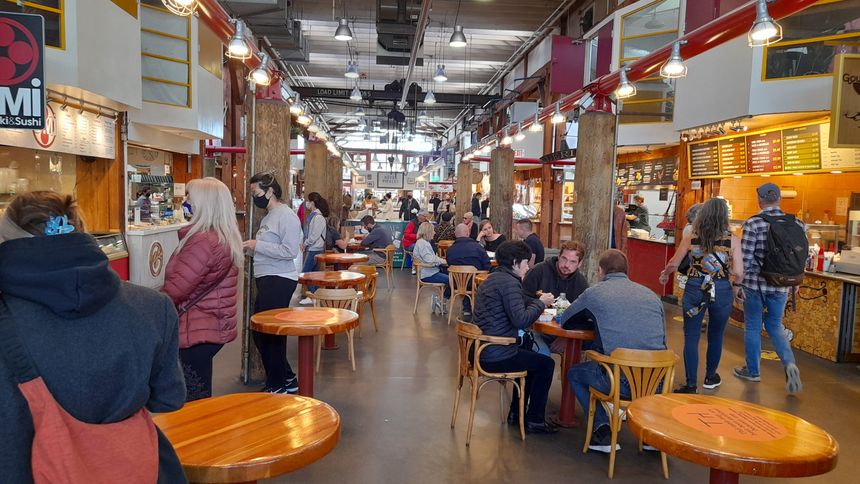
This case is related to a trip and fall incident that occurred at a mall food court. The plaintiff sustained a serious knee injury when he fell in the food court. The fall occurred while the food court was undergoing renovations that included replacing the existing flooring. The Food court remained open to the public during the staged renovation, with temporary flooring and warning signage in place. The plaintiff commenced an action against the owners of the mall and the mall security contractor. He alleged that his fall was caused by unsafe or uneven floor conditions that were either created or left unaddressed during the renovation work. However, CCTV footage of the incident revealed the plaintiff fell while performing a series of lunges. The defendants argued the Food court was reasonably safe and that the plaintiff’s own conduct caused the fall.
Court’s Findings
- Has the Plaintiff established the temporary flooring constituted an objectively unreasonable risk of harm to entrants?
- If yes, has the Plaintiff established that the Defendants breached their duty of care to the Plaintiff under the OLA?
The plaintiff put forward evolving theories for his fall. The plaintiff stated he tripped on a strip of tape, then he stated his shoe caught the tape while lunging, and finally he stated that he fell as a result of “rippled” or uneven carpet covering a hidden level change.
In determining whether the defendants were liable, Madam Justice Sukstorf stated that a plaintiff bears the burden of adducing positive evidence of an unsafe condition or an objectively unreasonable risk of harm, together with a causal nexus between that condition and the resulting injury. The plaintiff must demonstrate a causal link between a proven hazard and the fall, as the court cannot speculate.
The defendants installed temporary flooring transitions consisting of sheets of plywood fitted into gaps, covered with sectioned carpeting, and secured with heavy-duty construction tape. Warning signage reading “uneven surface” and “wet floor” was placed at visible locations throughout the area. The defendants conducted daily safety inspections at the end of each shift to ensure that the transitions and signage were secure and intact. Additionally, the defendants performed regular daytime inspections. There was no evidence of damaged, loosened materials, or any deviation from the established safety system. The CCTV footage played an important role in proving that sufficient safety procedures were in place in the food court.
The Court was satisfied the evidence as a whole demonstrated that the renovation conditions were readily apparent to users of the food court. The Plaintiff’s awareness of the conditions and his decision to perform lunges diminished the foreseeability of harm arising from the flooring itself.
The court was satisfied that the flooring system was installed and maintained in accordance with a reasonable and industry-standard safety protocol. The conditions were visible and adequately marked. The fall was caused by the Plaintiff’s actions rather than by some latent defect or unsafe surface. The conditions present did not exceed the ordinary risks of daily life that occupiers are not required to eliminate.
The court held that visitors must exercise a “modicum of awareness” for their safety. A “modicum of awareness” directly relates to a plaintiff’s ability to avoid an accident by exercising ordinary care.
The court found that the OLA does not create a presumption of negligence whenever an injury occurs, and that occupiers are not required to eliminate the ordinary risks of everyday life. The OLA imposes a duty of reasonable care, not a guarantee of safety. As such, the standard imposed by the OLA is one of reasonableness, not perfection. The deep and deliberate lunges performed by the plaintiff was sufficient evidence to show that the plaintiff did not exercise the required “modicum of awareness” for his own safety.
Key Takeaways
- Liability is not inferred just because there is an injury.
This judgment reaffirms that the mere fact a person was injured does not give rise to any presumption of negligence. The OLA imposes a duty of reasonable care, not a guarantee of safety.
- Endeavouring to deploy robust safety procedures is critical to meeting an occupier’s duty and standard of care.
Critically, the standard of care imposed by the OLA is one of reasonableness, not perfection. This judgment acts as clear guidance to help navigate and protect potential occupiers from liability. It is clear that deploying robust procedures that effectively bring any hazards to a visitor’s attention, while also actively mitigating against these dangers, is sufficient to meet the duty and standard of care imposed under the OLA.
- The value of preserving and obtaining CCTV footage in similar fact cases.
This judgment highlights the value of obtaining effective CCTV footage. In doing so, in this case, the defendants were able to bring an effective summary trial application.
/Passle/593009bf3d94760454b5e183/SearchServiceImages/2025-07-04-19-54-57-855-686831918714336e9f5574a9.jpg)
/Passle/593009bf3d94760454b5e183/SearchServiceImages/2026-10-21-20-05-50-519-6ad91b1e9207ce3b47036ebc.jpg)
/Passle/593009bf3d94760454b5e183/SearchServiceImages/2026-09-08-17-09-53-907-6aa04161fc3a116d3078baed.jpg)
/Passle/593009bf3d94760454b5e183/SearchServiceImages/2026-09-02-15-07-09-986-6a983b9d153afd561e2a83c7.jpg)