




In St Albert (City) v Melcor Developments Ltd, 2026 ABKB 213, the Alberta Court of King’s Bench considered whether a defendant could revive a limitation-barred claim by adding a former defendant as a third party under section 6 of the Limitations Act, RSA 2000, c L-12. This decision reinforces that section 6 cannot be used to circumvent expired limitation periods where the proposed third party lacked timely knowledge of the claim.
Background
The dispute here arose from alleged deficiencies in the design and construction of a drainage swale in a subdivision developed by Melcor Developments Ltd for the City of St. Albert.
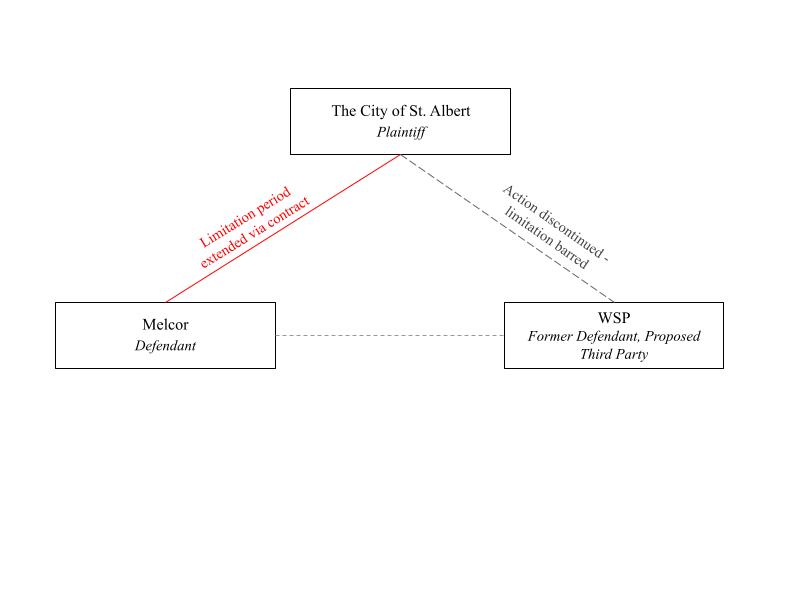
In 2005, Melcor retained WSP Canada Inc to provide engineering and project management services with respect to the subdivision. The City became aware of drainage problems in the subdivision in 2011 and obtained an expert report in October 2013, which it circulated to Melcor and WSP. In June 2017, the City filed a Statement of Claim against both parties.
A critical feature of this case was that the City and Melcor had contractually extended the limitation period for claims between them by four years. No such extension applied to WSP.
As the litigation progressed, the City discontinued its claim against WSP in November 2023 on the basis that the claim was limitation-barred. Melcor then sought to amend its Third Party Claim to add WSP back into the litigation, seeking contribution and indemnity.
Melcor relied on section 6 of the Limitations Act, arguing that the proposed Third Party Claim should be permitted despite the expiry of the limitation period.
Analysis
The viability of Melcor’s application turned entirely on whether section 6 of the Limitations Act could “save” the proposed claim.
Section 6 allows a party to add a claim after expiry of a limitation period if certain conditions are met. Where a defendant is added, the key requirements under section 6(4) are:
- The added claim must relate to the same conduct, transaction, or events; and
- The proposed defendant must have had sufficient knowledge of the claim within:
- The applicable limitation period; plus
- The time allowed for service.
In this case, the first requirement was not contested. Instead, the dispute focused entirely on whether WSP had the required knowledge.
The Court identified October 2016 as the critical date. October 2013 was when the expert report was obtained, and the Court added the two-year limitation period, plus one year for service. The central question was therefore: did WSP have sufficient knowledge of Melcor’s claim for contribution or indemnity by October 2016?
The Court said no. At that time, the City had not yet commenced its action (filed June 2017). There was no existing litigation in which WSP could have been aware of a contribution claim. The Court emphasized the logical impossibility of the situation. A party cannot have knowledge of a claim before the underlying action even exists. This finding was fatal to Melcor’s reliance on section 6.
The Court also raised a broader policy concern: it would be “passing strange” if a claim could survive as an added claim but not as a direct claim. Allowing Melcor’s application would effectively undermine limitation periods by permitting indirect revival of claims that were otherwise extinguished.
The Court also placed significant weight on the contractual extension between the City and Melcor. WSP was not party to the contract extending the limitation period, and drawing on analogous Ontario case law, the Court held that a party who benefits from a litigation extension must bear the associated risks. It cannot shift that risk to another party who had no role in the extension.
The Court dismissed Melcor’s application to amend its Third Party Claim.
Takeaways
- Section 6 has real limits and is not a workaround for expired limitation periods. The knowledge requirement is decisive and strictly enforced.
- Parties must consider third party claims early.
- A party cannot be said to have knowledge of a claim that did not yet exist.
/Passle/593009bf3d94760454b5e183/SearchServiceImages/2025-07-04-19-54-57-855-686831918714336e9f5574a9.jpg)
/Passle/593009bf3d94760454b5e183/SearchServiceImages/2026-09-08-17-09-53-907-6aa04161fc3a116d3078baed.jpg)
/Passle/593009bf3d94760454b5e183/SearchServiceImages/2026-09-02-15-07-09-986-6a983b9d153afd561e2a83c7.jpg)
/Passle/593009bf3d94760454b5e183/SearchServiceImages/2026-08-26-19-17-46-642-6a8f3bda2f61414a67f472ec.jpg)